








About
Kaizen started as one agency's internal system, and got shared
Kaizen was not designed in a boardroom as a product idea. It was built by Johnny Lowe, a UX and product designer who now runs his own digital agency, because after ten years in the industry he was tired of losing hours to the admin between the work.
It worked. So he opened it up.
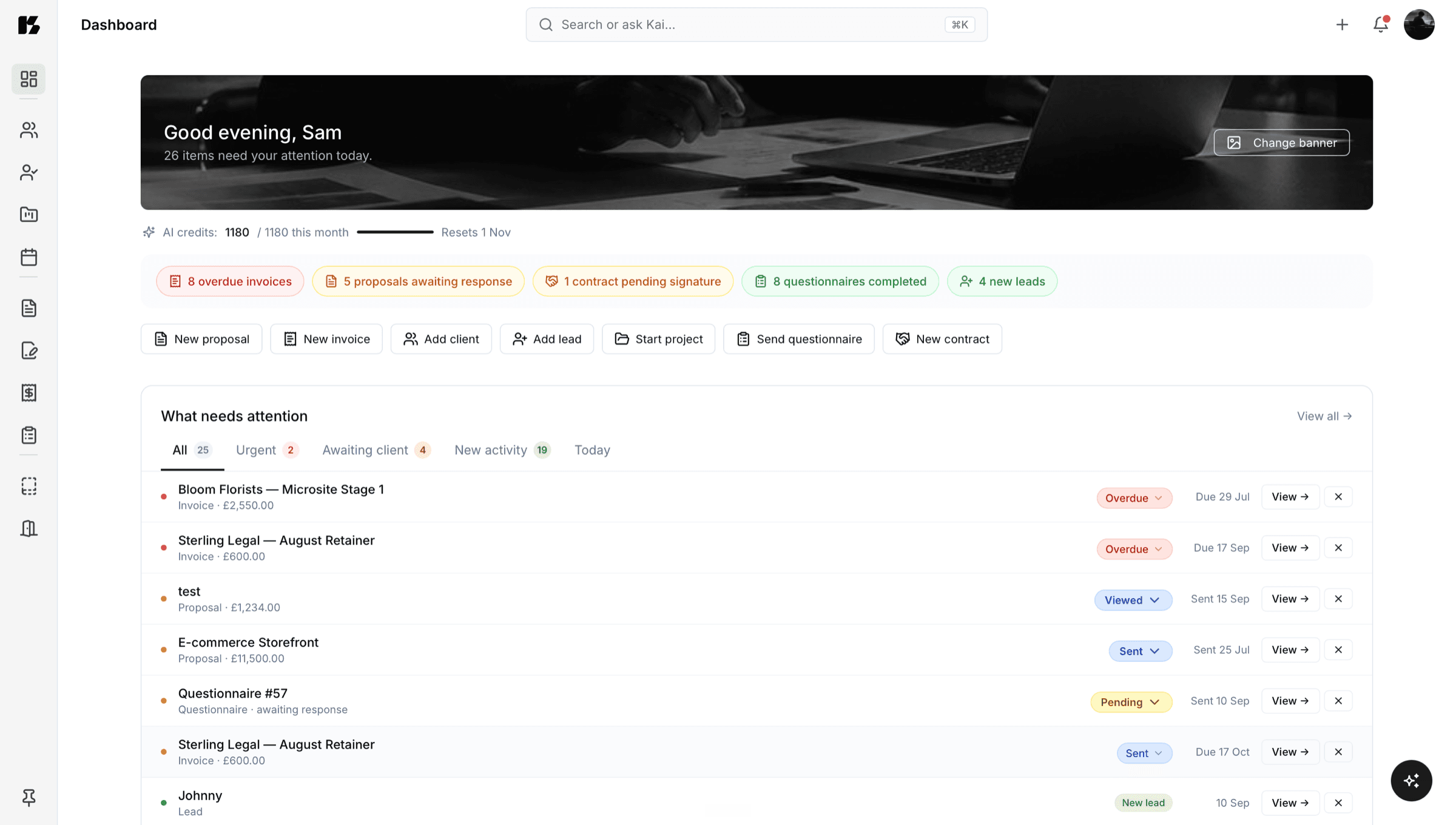
Ten years of running an agency teaches you something specific. The work is rarely the hard part.
The hard part is everything around it. The proposal you write on a Thursday night. The onboarding questions you ask over four separate emails. The invoice you meant to send a fortnight ago. The enquiry that arrived while you were on a call and quietly slid down your inbox.
None of it is difficult. All of it takes time, and all of it happens in a different app. That is not a workflow, it is a tax.
Johnny built a system to stop paying it. Clients in one place, leads in one place, invoices raised where the work already lived. The kind of thing you build for yourself because nothing on the market quite fits how you actually work.
Then other people started asking if they could use it.
Who builds it
It is a small team, so the person answering your email is usually the person who can fix the thing you are emailing about.
Johnny Lowe
Founder
Johnny is a UX and product designer who now runs his own digital agency, with ten years in the industry behind him. That combination is where Kaizen came from: the design half means the product is built rather than assembled, and the agency half means every feature exists because something was annoying him on a real job. He still runs the agency, so he is using Kaizen the same way you are, on real clients, with real invoices that need to go out.
LinkedInGareth McClune
Chief Executive Officer
Gareth comes from commercial operations, where the difference between a business that runs well and one that runs on adrenaline is almost always the system underneath it. He has seen what happens when there isn't one: work gets done, but at a cost nobody is measuring. He leads Kaizen with a fairly blunt goal, which is that using it should feel calmer than not using it.
LinkedInKaizen is for anyone who does work for other people and has to keep track of it. That means freelancers, agencies and consultants.
It also means small teams who have outgrown a shared spreadsheet but do not want enterprise software, and students starting to take on paid work who need to look professional from the first invoice.
That last group is part of why there is a free plan.
Why the free plan exists
Charging people just to send an invoice is a strange business to be in
You can use Kaizen for nothing, permanently. Client management, leads, lead forms and up to 10 invoices a calendar month, with no card required and no expiry.
The reasoning is simple. Most people find a tool like this at the point where admin has already got away from them, and that is usually the point where money is tightest. Putting invoicing behind a paywall means charging people just to send a bill for work they have already done, which is a strange business to be in.
So the free plan is a real one. If it saves you enough time that proposals, questionnaires and Kai start looking useful, Companion is £14.99 a month, or £150 a year. If it doesn't, keep using the free one.
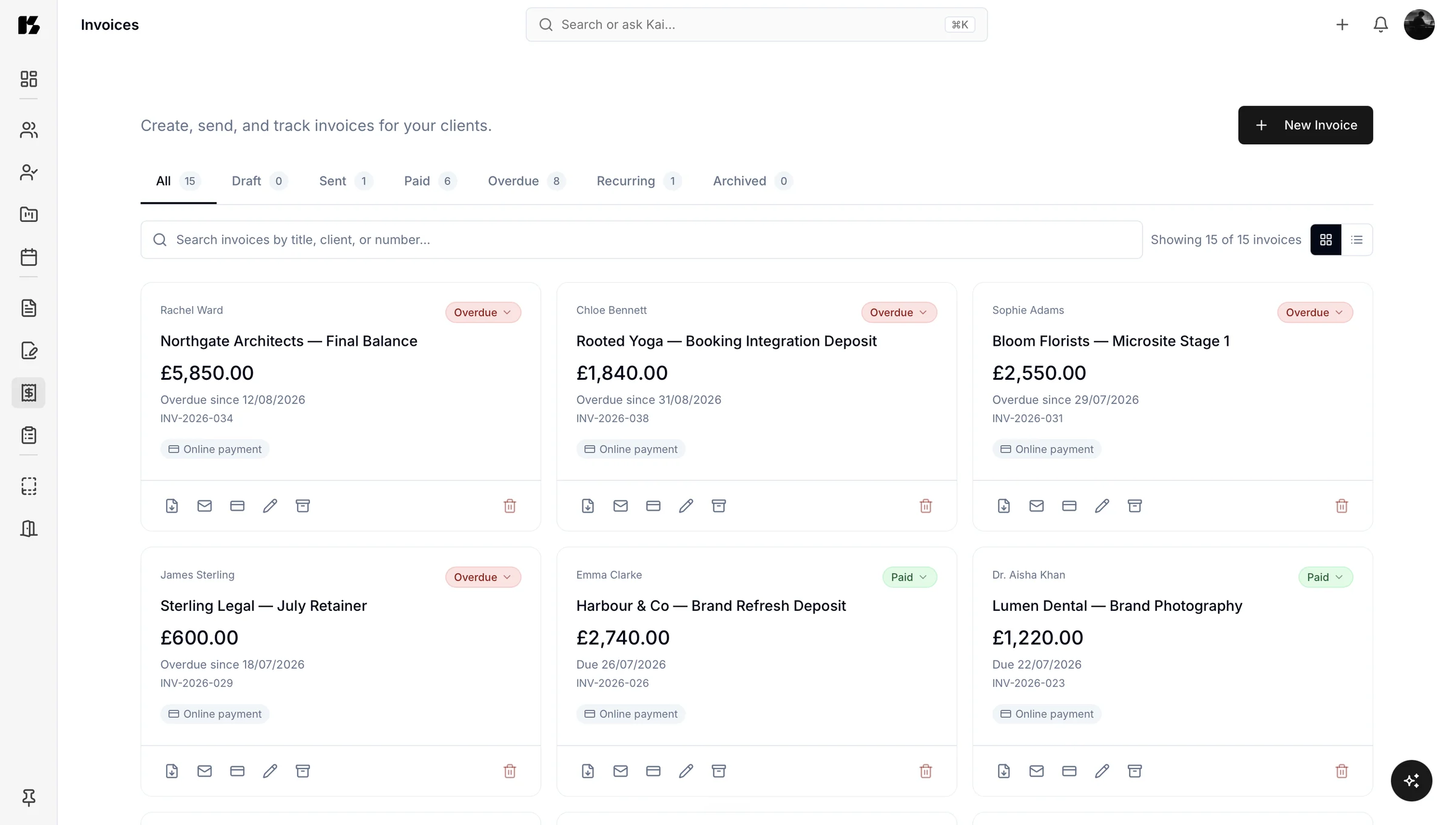
What the name means. Small, steady changes that compound into something significantly better.
Kaizen is a Japanese word meaning continuous improvement: small, steady changes that compound, rather than one dramatic overhaul nobody sustains.
It is how the product was built, one annoyance at a time over ten years of agency work, and it is how we suggest you adopt it. Move the messiest thing in first. Feel the difference. Move the next one.
We are also, for the record, an independent software product. Not affiliated with the Kaizen Institute or any lean manufacturing organisation. We share the name because we share the philosophy.

How we build
Boring where it matters
Your client records, leads and invoices need to be reliable and findable. We save the flair for the parts of the product you look at, not the parts you depend on.
You stay in charge
Kai drafts, creates and updates. It does not send things behind your back. Everything is reviewable before it leaves the building.
Fewer steps, always
Every release, we look for clicks to delete. If a job takes four steps and could take one, that is a bug.
See what Kaizen does, see who it fits, or come and say hello. We are small, so when you email us, one of us reads it.
Questions about Kaizen the company
Kaizen was founded by Johnny Lowe, a UX and product designer who runs his own digital agency, with ten years in the industry. It is led by CEO Gareth McClune, who comes from commercial operations. Johnny built the original system to run his own agency before rebuilding it as a product other people could use. It is a small team, so the person answering your email is usually the person who can fix the thing you are emailing about.
Johnny Lowe built Kaizen because ten years as a designer and agency owner meant losing hours every week to admin spread across separate apps. He built an internal system to keep clients, leads and invoices in one place, found it worked, and rebuilt it so freelancers, agencies, small teams and students could use it too.
Kaizen has a permanently free plan because people usually look for a tool like this when admin has already got out of hand, which is often when money is tightest. Putting invoicing behind a paywall would mean charging people just to send a bill for work they have already done. The free plan covers clients, leads and up to 10 invoices a month, and Companion is £14.99 a month.
Kaizen is a Japanese word meaning continuous improvement, the practice of making small, steady changes that add up to significant gains over time. We chose it because that is how the product was built and how we recommend adopting it: one messy process at a time, rather than a single overwhelming switchover.
No, Kaizen the business portal is an independent software product and is not affiliated with the Kaizen Institute or any lean manufacturing organisation. We share the name because we share the philosophy, not because we share an owner.